Credit Groups
  Careers
  Client Login
 Article
Credit Management
Sell More to Offset Bad Debt?

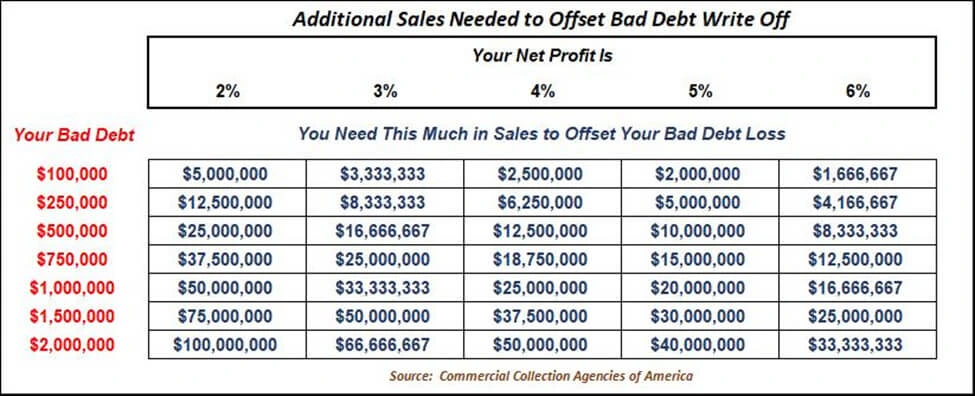
How many more sales must you generate to offset bad debt? With the recent pullback in the stock market, it reminds us that the economic winds are ever-changing. You may think twice about your credit policy if your sales team is chasing poor credit risks in a volatile economic environment. We wanted to provide you information and a helpful tool to quantify the impact of bad debt and the sales volume necessary to offset it.
The Real Cost of Bad Debt
We all know that bad debt is detrimental, but more importantly, bad debt goes beyond the obvious line item on your income statement. There are additional negative consequences resulting from high levels of bad debt. You lose cash flow, you have reduced profits, you lose people’s time in pursuing the sale, and you lose time and expense attempting to collect the debt. If your company’s funding is tied to an asset based loan, your lending costs and restrictions on your borrowing base can be crippling. The impact of a bad credit decisions is exponentially bad for your bottom line. The bad debt line item on your financials is just the negative number you see. Can you imagine what it would be if you included all those additional costs?
Solutions to Minimize Losses
IT’S NOT ENOUGH TO “SELL” MORE TO OFFSET LOSSES, THOUGHTFUL CREDIT AND COLLECTIONS POLICIES HELP YOU MANAGE RISKS AND REDUCE WRITE OFFS:
- Management sets credit review levels in order to see problems in their infancy. Seeing accounts early allows you to work with customers and resolve problems before those problems get out of hand.
- Many clients have routine meetings with finance, credit and collections, and sales. The purpose is to discuss problem accounts and develop effective strategies to recover money. it allows you to achieve a buy in from all stakeholders.
- Employ regimented in-house collection programs based on balance size. Contact customers in priority order (largest to smallest) to minimize bad debt. If customers don’t pay, their balance is escalated to the next step.